
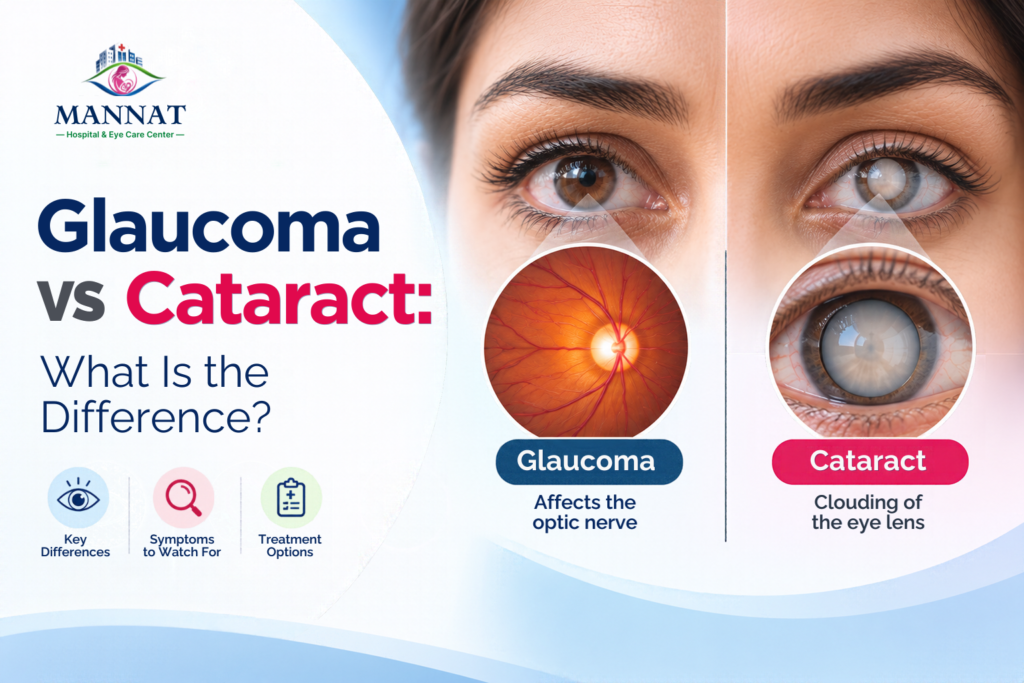
Cataract and glaucoma are two of the most common eye conditions in older adults. Both can blur or reduce your vision. Both become more likely with age. People often mix them up, and some assume they’re the same problem at different stages. They’re not. Understanding glaucoma vs cataract matters, because the two conditions behave very differently and need very different care. Here’s a clear breakdown.
A cataract is a clouding of the eye’s natural lens. A glaucoma is damage to the optic nerve, usually linked to pressure inside the eye. The lens works like a camera lens, and the optic nerve works like the cable that carries the picture to your brain. Cataract fogs the lens. Glaucoma damages the cable.
What Is a Cataract?
The lens sits behind your pupil and focuses light onto the retina. Over time, proteins in the lens clump together and make it cloudy. Light has trouble passing through, so vision grows hazy. Cataracts usually develop slowly, and they’re a very common part of aging.
What Is Glaucoma?
Glaucoma is a group of conditions that damage the optic nerve. In most cases, pressure inside the eye rises because fluid doesn’t drain properly. That pressure harms the nerve fibers over time. Some people develop glaucoma even with normal eye pressure. Because the optic nerve can’t regrow, the damage is permanent.
Glaucoma vs Cataract: Side-by-Side Comparison
| Feature | Cataract | Glaucoma |
|---|---|---|
| What’s affected | The lens | The optic nerve |
| Main cause | Aging, diabetes, injury, steroids, UV exposure | Raised eye pressure, though some cases occur with normal pressure |
| Typical early symptoms | Hazy or cloudy vision, glare, halos, faded colors | Often none. Side (peripheral) vision narrows slowly |
| Pain | Usually painless | Usually painless, except in sudden angle-closure glaucoma |
| Speed | Gradual, over months to years | Often very gradual. Rarely sudden |
| Vision loss | Reversible with treatment | Permanent once it happens |
| Main treatment | Surgery to replace the clouded lens | Eye drops, laser, or surgery to lower pressure |
| Outlook | Vision usually improves after surgery | Treatment protects remaining vision but can’t restore lost vision |
How the Symptoms Differ
Cataract Symptoms
- Blurry, hazy, or cloudy vision
- Glare from sunlight or oncoming headlights
- Halos around lights
- Colors that look faded or yellowish
- Difficulty seeing at night
- Frequent changes in glasses prescription
- Double vision in one eye
Our guide on early signs of cataract lists ten signs worth watching for.
Glaucoma Symptoms
Most people with the common form, open-angle glaucoma, notice nothing at first. Side vision fades slowly, and the brain compensates, so the loss often goes unnoticed until it’s advanced. That’s why doctors call glaucoma the “silent” eye disease. Our guide on glaucoma’s early warning signs explains this in detail.
The Emergency Form of Glaucoma
One type behaves differently. Acute angle-closure glaucoma raises eye pressure suddenly. It can cause:
- Severe eye pain
- Blurred vision
- Halos around lights
- Nausea or vomiting
- A red eye
This is a medical emergency. Go to a hospital immediately if you notice these signs. Our guide on sudden blurred vision explains which warning signs need urgent care.
Why People Confuse the Two
- Both affect people more often as they get older
- Both can reduce vision
- Both can run in families, and both link to diabetes
- Both are common enough that many people know someone who has one
The key difference lies in what each does to your sight. A cataract makes the whole picture look foggy. Glaucoma usually shrinks the edges of your vision first, like looking through a narrowing tunnel.
Can You Have Both at the Same Time?
Yes. Both conditions are common in older adults, so many people develop each of them. Having a cataract doesn’t protect you from glaucoma, and having glaucoma doesn’t prevent cataracts. Your eye specialist checks for both during a full exam. Treating one doesn’t treat the other. Cataract surgery, for example, doesn’t cure glaucoma.
Who Is at Risk?
Risk factors overlap, but they aren’t identical.
Cataract risk factors:
- Increasing age
- Diabetes
- Long-term steroid use
- Eye injury or previous eye surgery
- Heavy smoking
- Long-term, unprotected sun exposure
Glaucoma risk factors:
- Age above 40, with higher risk after 60
- A family history of glaucoma
- High eye pressure
- Diabetes
- Long-term steroid use
- Eye injury
- Very high nearsightedness or farsightedness
How Do Doctors Tell Them Apart?
A comprehensive eye exam answers the question. The specialist looks at your lens for clouding, which confirms a cataract. They also measure your eye pressure, examine your optic nerve, and test your side vision to check for glaucoma. A person can’t reliably tell the two apart by symptoms alone, especially since glaucoma often has no symptoms. Our broader guide on common causes of blurry vision explains why a proper exam matters.
Treatment: How the Approaches Differ
Treating a Cataract
Glasses can help in the early stages. When the cataract starts affecting daily life, surgery removes the clouded lens and replaces it with a clear artificial lens. Modern phaco surgery is a short, minimally invasive procedure, and most people see a clear improvement afterward.
Treating Glaucoma
Treatment aims to lower eye pressure and protect the remaining vision. Options include:
- Daily eye drops
- Laser treatment to improve drainage
- Surgery in more advanced cases
Glaucoma needs lifelong monitoring. Even well-controlled glaucoma requires regular check-ups.
Common Myths
“Eye drops can dissolve a cataract.” No proven eye drop removes a cataract. Surgery is the effective treatment once it affects your life.
“Glaucoma always comes with high eye pressure.” Not always. Some people develop glaucoma with normal pressure, which is why a full exam matters.
“Cataract surgery will fix my glaucoma.” No. Cataract surgery treats the lens only. Glaucoma needs its own management.
“If my vision is fine, my eyes are fine.” Not necessarily. Glaucoma can damage the optic nerve for years before you notice any change.
When Should You See an Eye Specialist?
Book an eye exam if you:
- Are over 40 and haven’t had a full eye check-up recently
- Have diabetes, a family history of glaucoma, or take long-term steroids
- Notice hazy vision, glare, or halos
- Find that your side vision seems to be shrinking
- Need new glasses much more often than usual
Don’t wait for symptoms if you’re in a higher-risk group. Early detection protects your vision.
Why Choose Mannat Hospital for Cataract and Glaucoma Care
At Mannat Hospital & Eye Care Centre, a comprehensive eye exam looks for both conditions, so you don’t have to guess which one you’re dealing with. Dr. Bhavesh Makkar, a fellowship-trained eye specialist, provides modern phaco cataract surgery, along with care for glaucoma, retina conditions, and diabetic eye screening.
FAQs
What is the main difference between glaucoma and cataract? A cataract clouds the eye’s lens, while glaucoma damages the optic nerve. Cataract vision loss can be reversed with surgery, but glaucoma damage is permanent.
Which is more serious, glaucoma or cataract? Glaucoma is generally more serious, because the damage can’t be reversed and often goes unnoticed. Cataracts are very common and highly treatable.
Can cataract turn into glaucoma? No. They’re separate conditions. However, a very advanced cataract can sometimes raise eye pressure, which is one reason doctors don’t ignore overripe cataracts.
Can you have glaucoma and cataract at the same time? Yes. Both are common in older adults, and many people have both. Your eye specialist checks for each.
Does glaucoma cause blurry vision like a cataract? Early open-angle glaucoma usually doesn’t blur vision. It narrows side vision first. Blurring tends to appear later, or in sudden angle-closure glaucoma.
At what age should I get checked for glaucoma and cataract? Adults should have a full eye exam by age 40, or earlier with risk factors, and repeat it every one to two years as advised by their eye specialist.
Not Sure Which Condition You’re Dealing With?
Book a comprehensive eye exam with Dr. Bhavesh Makkar at Mannat Hospital & Eye Care Centre and get a clear answer.
Related Reads: